Process
I helped lawyers communicate beyond their “jargon paradigm” to reach their ideal potential clients, either in their current or aspirational areas of legal practice. I started by interviewing each lawyer, getting an idea of their voice, interests, and audience.
After that, I researched topics to form the basis of written pieces. The lawyers chose their preferred topics, and I did the writing as well as revisions from their notes.
Most pieces fell into either short-form (social post) or long-form (blog post) formats. These were proliferated through professional social platforms, like LinkedIn, or email marketing – with the blog post introductions and links sent in a newsletter to a list of organically accumulated contacts.
The posts cultivated new leads, both warm and cold, and reminded existing clients of the lawyer’s services, expertise, and availability.
Skill Highlights
Content Design
Brand Voice
Marketing Strategy
Research
Blog Writing
Short-form Writing
Technical Writing
Editing
Email Marketing
Project Management
Why is Disney So Placid About Mickey Mouse Entering the Public Domain in 2024?

Who has two ears, two gloves, and lives in the happiest place on earth? Mickey Mouse is one of the most recognizable figures on the planet, and his likeness is owned by Disney. He is a valuable creative and commercial symbol indeed.
Since the passage of the Copyright Act of 1976, we have been observing waves of previously copyrighted material entering the public domain. Now, in January 2024, we will see Mickey Mouse go through this change. What does it mean for Disney?
Steamboat Willie
As you may have learned, in the arena of intellectual property law, conclusions depend upon the details. It is true that a version of Mickey Mouse will lose copyright protection in 2024. And that version is Steamboat Willie.
The original iteration of Mickey Mouse, Steamboat Willie was the main character of an animated short released in 1928. The cartoon garnered attention in its time, because it was the first to sync sound and visuals, creating a rich, animated world.
When Steamboat Willie’s 95 year protection expires, other artists will be free to employ his image as they wish in their own written, visual, and filmic works.
So why does it seem that Disney is not concerned?
Copyright Protection vs. Trademark Protection
For starters, Steamboat Willie lacks some of the distinctive characteristics of modern Mickey Mouse. Since the film was in black and white, he does not boast Mickey’s bright red trousers. His hands are gloveless. And he sports a long, thin tail, which seems to have been phased out over time, perhaps to make Mickey resemble more of a cute little mouse than a gangly rat.
More importantly, however, Disney owns more than the copyright for various iterations of Mickey Mouse over time. Disney owns the Mickey Mouse trademarks as the prime representative of its entertainment empire.
When do trademarks expire? As long as they are actively in use — never.
Use the Mouse Carefully
These reasons are likely why Disney has not tried to pull any legal strings, as behemoth corporations are wont to when their bread and butter are threatened. Disney’s bread and butter are firmly anchored to distinct, registered trademarks.
However, creators need to keep this in mind when employing Steamboat Willie’s likeness, even if he is in the public domain. If they step on the toes of Disney’s legitimate trademarks, they could still find themselves in deep legal trouble. It would be wise to show your work to an IP expert before publishing it just to make sure the work does not infringe on any registered trademarks or copyrights.
*
Tyler Perry, Kyrie Irving, and Snoop Dogg Help Widow Fight Property Developer
Published as a blog post for client education and SEO.
While a developer trying to muscle their way around property law might not seem like a heart-warming holiday tale, this month’s blog does have some kind of holiday-worth conclusion: the power of good-neighborliness and the internet’s expansion of our neighborhoods. When a widow was sued by Bailey Pointe Investment for her front porch allegedly encroaching on their property, people far and wide raced to support the 93-year-old — who inhabits multigenerational land which has been passed down for over a hundred years.
David (Josephine) and Goliath (BPI)
Josephine Wright first moved to her home on Hilton Head Island in South Carolina in the ’90s — the 1.18 acreage plot having been in her husband’s family since just after the Civil War. After her husband passed away in the late ’90s, Wright officially acquired the title in 2012.
In 2014, Bailey Point Investment LLC (BPI) bought a large parcel of land on Hilton Head, essentially surrounding Wright. Their broadcasted plan for the land has been consistent: develop and build 147 new homes.
According to Wright’s family members, a representative of BPI showed up at Wright’s door in 2018, offering her $39,000 for her home and land. As stated in her eventual counterclaim, Wright told BPI that her land was not for sale.
BPI subsequently complained that Wright’s satellite dish, shed, and front porch were encroaching on their property, and sent a letter demanding that Wright move the structures. Wright removed the satellite dish and the shed. According to her GoFundMe page, Wright spent $2,000 to have the shed taken down. But it was when Wright approached plans and costs to downsize her porch that something changed.
The Last Straw: the Porch
In February 2023, BPI sued Wright, alleging that her front porch, by encroaching on their property, had significantly slowed their development. BPI’s claims amounted to:
- Continuing trespass
- Nuisance
- Injunctive relief — requiring Wright to remove the encroaching porch
- Legal fees
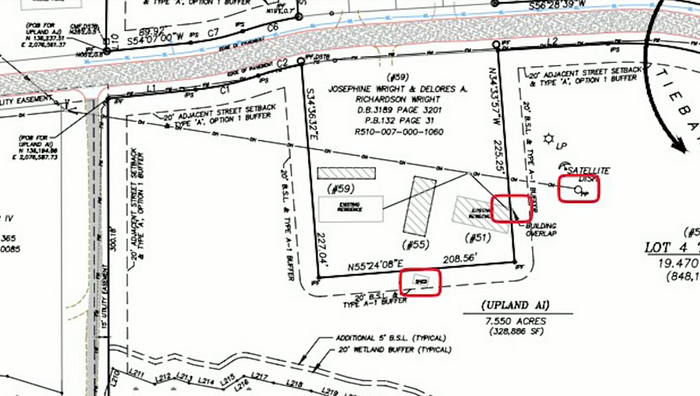
Instead of acquiescing to the developer’s demands, Wright chose to file a counterclaim. She put her reasoning simply: “My porch is not on their property.”
If your eyebrow is arching at a large developer being unable to build any of the planned 147 houses because a single front porch toes the property line — you are not alone.
A History of “Intimidation”
No one can know BPI’s intentions for sure, but the linear sequence of events certainly gives an impression:
- BPI bought property surrounding Wright’s land.
- BPI made an offer to buy Wright’s land.
- Wright refused BPI’s offer.
- BPI made demands of Wright and framed her as “in the wrong.”
- BPI sued Wright.
Wright’s counterclaim describes BPI’s actions as “tactics of intimidation, harassment, trespass, to include this litigation in an effort to force her to sell her property.”
With ample historical evidence regarding land inequality specific to that area, Wright’s argument that BPI is not acting in good faith is a strong one. Members of the Gullah Geechee community (families of formerly enslaved people) retreated to the Beaufort Sea Islands of South Carolina after the Civil War to find respite from mainland racism. Now, their island property is quite valuable. To quote the Wright family attorney, Roberts Vaux, as he spoke to the Island Packet press:
“I can’t say that that’s what these people [Bailey Point] are doing, but that’s something that I’ve seen in the last 51 years practicing law on Hilton Head Island and in Beaufort County. If in fact that’s what they’re doing, which I don’t know that it is, but if it is, it wouldn’t be the first time I’ve seen it.”
Support from the Stars & the Global Community
Perhaps this modern context to the issues of land inequality — combined with Wright’s determination and charming personality — is what caught the attention of several Black celebrities, as well as friends and strangers all over the world on GoFundMe. Notable contributors have donated tens of thousands of dollars to Wright’s cause, including:
- Tyler Perry
- NBA star Kyrie Irving
- Snoop Dogg
Altogether, the GoFundMe exceeded its goal of $350,000 and stands at $365,905 as of November 2023. Wright said that she’ll use any money that doesn’t go to legal fees to fund the education of children in her outstretching family tree.
And this is where the David and Goliath real estate story takes the slingshot turn. As of September 2023, the lawsuit has moved to mediation with the potential outcome being that BPI won’t get the injunction or damages they had in mind.
Whether and what settlement Wright and BPI may reach is unknown, but the outpouring of support for Wright shows that when we need help, there are still good neighbors out there willing to lend a hand. I don’t get to say this often about a property dispute, but prospects are hopeful. It may not be real estate law holiday cheer, but it’s a comforting reminder that most of us just want to help.
*
NY SB S7527: Why the Free Speech of Rappers Needs Extra Protection
Published as a LinkedIn post for social engagement.
Can song lyrics be used against a person as evidence in a criminal case? Or is that a First Amendment violation?
The First Amendment does not protect a person from criminal indictment if actions accompanied their words — even if their words were expressive on top of that.
For instance, a person who posts hateful speech and commits assault can’t argue that criminal prosecution for the assault also violated their free speech rights.
However, if a person receives criminal allegations based purely on their expressive speech, it can be considered persecution — and a violation of First Amendment rights.
To confront this in real life: in NY, SB S7527 was recently passed to counter a prominent tactic used against artists in the rap genre. For years, rap lyrics have been admissible in court as evidence. They have been used to demonstrate a rapper’s intent, conspiracy, or confession of guilt. They have also lassoed friends and family mentioned into incrimination. Sometimes they have formed the basis of racketeering claims, because prosecutors have labeled rap posses as “gangs.”
The bill requires that prosecutors must demonstrate concrete ties between song lyrics and real life criminal activities — not just suggestions.
What stands out most about this practice: Lyrics in other genres of music are not subject to the same literalism or scrutiny. And research has shown that the dominant Black and Latinx cultures of rap artists are underrepresented in judicial and criminal systems.
In other words, many prosecutors and judges don’t “get” rap music — and they are pursuing or allowing an inherently racist prosecutorial method.
Yet, as one author of Rap on Trial; Race, Lyrics, and Guilt in America points out:
“…To criminalize it has a chilling effect on speech, particularly because a lot of rap music is political in nature, which is the type of speech that should be entitled to the most protection in this country, but we’re seeing the opposite.”
And, as we well know by now, oppressing the political speech of one population threatens the free speech of the whole society.
*
Why It’s Worth Offering Unpaid Time Off
#worklifebalance #hrbestpractices #goodhrpolicies
Published on Lynch Law blog — June 9, 2023
Why It’s Worth Offering Unpaid Time Off
Unpaid time off may not sound like much of an offer. After all, who wants the opportunity to not get paid? However, don’t underestimate its value to potential and current employees — and, subsequently, its importance to your company.
Especially in the wake of the pandemic, flexibility is key for many workers. And their choices about where to work and how long to stay hinge on offers of flexibility.
We’ll go through the benefits of unpaid time off, how to field the challenges, and how dealing with it proactively rather than reactively can really benefit your business.
Unpaid Time Off Basics
Unpaid time off has a fairly straightforward definition: it is any amount of time taken by an employee when they would normally be doing something other than work.
To be less abstract about it, here are some common examples:
- Sick days — if a company doesn’t offer paid sick days
- Parental leave — in many states, the best or only option for new parents is to take off a few months without pay (which merits a whole other discussion in another blog post)
- Medical leave — similar to parental leave above
- Bereavement leave — again, taking time to attend to an important life transition
- Furlough — this stipulates that an employee is taking unpaid time off, but they retain their benefits with the company
- Sabbatical — much longer breaks from work, spanning months or years, which are not necessarily unpaid, but they can be
Keep in mind that, legally, FMLA requires employers of a certain size to give employees 12 weeks of unpaid leave. If your company grows enough, you may be compelled to create a UTO policy.
How Could This Be Advantageous to Employees and Employers?
From a short-sighted perspective, unpaid time off can look like a loss. The employee loses wages, and the employer loses productivity.
It’s mainly from the vantage point of the bigger picture that unpaid time off starts to shine. What it provides is a sort of “release valve” for an employee who wants to stay at a company in the long-term — but they need a break, for whatever reason.
For instance, let’s say an employee has long dreamed to visit another country to delve into their family tree, and they want to do so while certain relatives are still alive. Such an endeavor might need 3–4 weeks (or more) of their time.
If their company is inflexible and replies to their request with “No, you only have two weeks of PTO, and that’s it,” the employee may find themselves in the position of having to choose between an important aspect of their life and work. The employee may choose their life goal and quit the job in order to take off several weeks — planning to figure out new employment later.
Now, that company has lost more than a few weeks of this employee’s contributions. They have to go through the hiring and training process for a whole new person, with the hope that this person won’t quit when they need more than two weeks off.
Lacking an unpaid time off policy can also create untenable situations when ill health strikes. If an employee tests positive for COVID for 10 days, and they’ve already used all their PTO for the year, are you going to require them to come into work? Are you going to write them up for absences?
Neither seems fair, humane, or healthy for the individual worker — or your workplace as a whole. Targeting an employee with rigid disciplinary actions for attendance when it’s better for them to stay home breeds resentment. Again, look at the big picture. Prioritize retainment over rehiring.
We’ve gone through scary examples. Now, let’s iterate the opposite. Let’s say an employee wants to work reduced hours (which is a form of unpaid time off) in order to take a coding course for a semester. Their company agrees to this arrangement for 3 ½ months. At the end of that time, the employee returns to working full-time hours — and they bring a new skill to their position!
Not only has the company retained an employee and avoided costly rehiring — they’ve grown the happiness and value of that employee’s productive contributions. This helps create a lasting work relationship.
To summarize, offering unpaid time off can help retain employees and grow your company with these benefits:
- Time to attend to important life events, needs, and desires, increasing goodwill in the employer-employee relationship
- Burnout prevention or recovery
- Room for education and skillset growth in your workforce
- Allowance for sick days — greater health and wellness/reduced company-wide sickness
- Flexibility for major transitions, like parenthood and bereavement — employees feel like they can live their life and keep the same job
Proactively Structure Unpaid Time Off
It’s best to decide how your company wants to handle unpaid time off before employees ask for it. You can create a policy and include it in the employee handbook and orientation. You can even explain some of these benefits so that potential hires understand why they should choose your company over one that doesn’t offer unpaid time off.
Now, how to structure your UTO policy? Consider these factors:
- How will you manage payroll during UTO for salaried vs. hourly employees?
- Will you place a cap on UTO or offer unlimited UTO?
- How will the number of unworked hours affect your company’s output and bottom-line?
- Will you limit the number of employees taking UTO concurrently?
- What is your plan for covering employee tasks and responsibilities when they take UTO?
Addressing these questions ahead of time will help make transitions from regular work hours to UTO smooth for the employee taking the time and their team.
Ready to Add Your Own UTO Policy?
Putting together a UTO policy that benefits both your employees and your business can feel daunting — but you don’t have to do it alone. If you are considering offering unpaid time off to your workforce and want some guidance on best practices, the Lynch Law can help.
Reach out today for a free consultation.
*
Are Tiny Houses an Affordable Housing Solution? It Depends on Who You Ask
The “tiny home” has existed in the American housing landscape since at least the 1980s, although cottages, cabins, trailers, and small bungalows have existed for much longer without the umbrella term.
The modern concept harkens a movement to downsize, simplify, and live in a more minimalistic way. With the emergence of more tiny homes comes a much-debated question: are tiny houses an affordable housing solution?
The answer, not surprisingly, is both “Yes” and “No.” It’s probably best summed up as, “It depends on the context.” In this article, we will take a tour of the pros and cons of tiny houses to help elucidate their place in affordable housing strategies.
Pros
Quick Builds
Since tiny homes require fewer materials overall, builders can construct them more quickly and at a generally lower cost than an average-sized home. If the financing, location, and supply chain line up well, a tiny house can be completed within 30–45 days of ordering it — while the average time to build a new, single-dwelling home is seven months. In fact, it’s not uncommon for new builds to take a year or longer.
This is why some cities have used tiny home communities so effectively to mobilize people from houselessness to housing stability. While the structures may be very minimal — one-room with a basic kitchen and bathroom — they allow people to store their belongings, sleep in safety, and have a permanent address.
When quality housing can be produced quickly and cheaply, residents are more easily able to put down roots, find employment, and develop a sense of community. While no single solution will ever work as a way to provide affordable housing for all, you can see how tiny houses could comprise a major housing solution for unhoused people.
Accessible Home Ownership
Tiny homes make home ownership more possible. The price tag for a tiny house typically falls way below most larger home prices, ranging from $16,000 for a 100-square foot cottage on wheels to $150,000 for a luxury, multi-room tiny home built on a foundation. You can find many suitable tiny houses with multiple sleeping spaces in the $40,000-$70,000 range.
While that amount of money may not sound “inexpensive,” consider that the mortgage industry has moved to keep up with tiny home demand. Potential buyers can now acquire an RV or tiny-house-specific mortgage, meaning that they only need to be able to afford a down payment — likely below $10,000, sometimes $0 down — as well as the monthly payments for that tiny house.
For people who are financially sound enough to pay rent but may struggle to save up for a larger down payment, they can likely manage this financial responsibility — opening up new opportunities for home ownership to a wider population.
This also facilitates a tiered approach to ownership, building both equity and passive income. First, a person can buy their tiny home. Later, they can buy land. When a tiny homeowner becomes a landowner, they may want to build a larger house on the land and keep the tiny house as an ADU for passive rental income. Keep in mind that this is possible if the tiny home is movable — and many are for just this reason!
More Housing Supply
We have yet to address the bottom-line of pro-tiny house arguments: when a community fits tiny houses into whatever spaces are available, overall housing supply increases. That can help increase affordable rent and mortgage options both in the wider market and through the lower-price pockets of specific tiny home offerings in an area.
Cons
Inefficient Usage of Land Space Compared to Denser Housing
While part of the tiny house dream is having your own little yard surrounding it, this also draws criticism. Proponents of denser housing argue that placing one or even a few tiny houses on an acre of land is a much less efficient use of that lot as compared to a dense, highly vertical, multi-family housing unit.
You can probably see how these housing structures appeal to quite different sensibilities. One simulates the “American Dream” house of a picket fence with a yard, just in micro conditions — while the other embraces a new, more urban vision of “American Dense Housing.”
Some would also rebut that, if a single family home has a backyard, adding a tiny house increases density where it’s possible, in a realistic way. Put another way, that homeowner is not going to add a condo tower next to their vegetable garden in the back.
Lack of Traditional Equity-Building
Since tiny homes don’t include land ownership, they don’t appreciate in the same way as other real estate. While the pros of movability and tiered ownership above still stand, some critics believe that the lack of equity in tiny houses does not make them worth the investment in the first place.
It is something to consider — if you have almost enough saved up for a down payment on a traditional house, it may be worth waiting a bit longer in order buy a house on land.
Tiny Homes Don’t Address Conjunctive Affordable Housing Issues
Tiny homes do not ameliorate the issues of urban overcrowding, decreasing wage power, or effective public transit, which are part and parcel of the affordable housing/living conversation.
Since tiny homes would need to be in proximity to transit, jobs, and food to truly increase affordable housing supply, they need to be in more central locations. Unfortunately, it can prove a challenge to place them in urban centers. Why? The core competition in urban centers happens over available land — any available land at all. A smaller house will not solve that problem.
Mostly, tiny homes work well when they fit into existing structures. Sometimes this puts tiny house communities on the edge of town, far from amenities and jobs, which poses the same transportation challenges and costs as other housing projects. As with our evaluation of mixed-income housing, tiny house building needs to be accomplished with intentionality in order to truly change a community for the better.
One Wave in a Sea of Solutions
So, are tiny houses an affordable housing solution? Absolutely! They just aren’t the solution.
It would behoove public housing agencies and lawmakers to stop looking for a panacea that likely doesn’t exist. While a tiny home may not be a good fit for all situations, it is still a viable option for some people in certain situations. They can give families a much-needed home when the alternative is homelessness, and they can act as a stepping stone to homeownership and eventual land ownership for folks who are gradually building wealth.
In short, we need to view tiny homes as one of many tools in the affordable housing toolkit and focus on utilizing those tools effectively.
 Angela Gets Creative
Leave a comment